
The Fee Most Car Shoppers Never Think to Compare
This post is part of our “Shop Smarter” series, helping consumers navigate today’s car market with confidence.
You’ve negotiated the price. You’ve agreed on a trade-in value. You think you know what you’re paying.
Then you sit down to sign the paperwork, and there it is: a line item you never discussed, adding hundreds of dollars — sometimes over a thousand — to the total. It’s called the dealer conveyance fee, and it’s one of the least understood costs in the entire car-buying process.
What Is a Dealer Conveyance Fee?
In Connecticut, the dealer conveyance fee — sometimes called a doc fee or processing fee — is a charge that dealerships add to cover the administrative costs of completing a vehicle sale. This includes preparing paperwork, processing your registration with the DMV, handling title transfers, filing lien documents if you’re financing, and other closing-related services.
Under Connecticut law (CGS § 14-62), dealers are permitted to charge this fee to “recover reasonable costs for processing all documentation and performing services related to the closing of a sale.” The fee is not paid to the state — it goes entirely to the dealer.
Here in Connecticut, there are real costs that a dealership incurs to transfer title and handle registration, and to a degree our State DMV is responsible. Over the past ten years or so, in an effort to free up wait times at DMV offices, Connecticut contracted with a software company and began licensing dealers to essentially do the DMV’s work. Authorized dealerships now pay a subscription for this software, keep a significant performance bond on file with the state, and pay a per transaction processing fee.
The customer gets actual hard plates and a complete registration at the time of delivery. Without this service, a customer would have to make an appointment in advance with DMV, typically two-three weeks in advance, to stand in line and process their registration in person.
Here’s the catch: Connecticut does not cap this fee. Unlike at least 15 other states — where doc fee limits range from $85 in California to about $565 in Missouri — Connecticut dealers can charge whatever they consider “reasonable.” And the definition of “reasonable” varies wildly from one dealership to the next.
How Much Are Dealers Actually Charging?
Way back in 2016, a Connecticut General Assembly study found that the average conveyance fee among new-car dealers in the state was $405 — but that data is now over a decade old. The landscape has changed dramatically since then.
Today, conveyance fees at Connecticut dealerships commonly range from $699 to $995. Some dealers charge even more — we’ve seen fees of $1,200 to $1,500 and higher in the region. To put that in perspective: on a $35,000 vehicle, the difference between a $489 fee and a $1,200 fee is $711. That’s real money — money that most shoppers never think to compare because they’re focused entirely on the vehicle price.
One Connecticut consumer law practice put it bluntly: fees were under $100 at most dealerships just 20 years ago. Today, some have climbed to nearly ten times that amount.
Why This Matters More Than You Think
Here’s how the conveyance fee can quietly undermine what you thought was a great deal.
Imagine you’re comparing two dealerships — Dealer A and Dealer B — both offering the same vehicle:
- Dealer A lists the vehicle at $34,500 with a conveyance fee of $995
- Dealer B lists the vehicle at $34,927 with a conveyance fee of $489
At first glance, Dealer A looks like the better deal — $427 less on the sticker price. But once you add the conveyance fee, the picture flips:
- Dealer A total: $35,495
- Dealer B total: $35,416
Dealer B — the one that appeared more expensive — is actually $79 cheaper. And that’s before factoring in the possibility that Dealer A’s listed price might include conditions or assumed rebates that inflate the gap even further.
 This is exactly the kind of comparison that online deal rating systems don’t make. They evaluate the listed price, not the out-the-door cost. A dealer with a high conveyance fee and a low listed price can earn a “Great Deal” badge while actually costing you more.
What Connecticut Law Requires
While there’s currently no cap on conveyance fees in Connecticut, the law does include some important consumer protections:
Disclosure is required. Dealers must prominently display a sign in the area where sales are negotiated, specifying the amount of the fee, the services it covers, and the fact that it is not payable to the state.
The fee is negotiable. By law, dealers are required to notify prospective buyers that the conveyance fee is negotiable. In practice, most dealers treat it as a fixed charge — but you have every right to ask.
It must be separately stated. When a dealer provides a selling price, the conveyance fee must be listed separately. It cannot be silently rolled into the vehicle price at the time of signing.
It’s worth noting that this issue is actively being debated in Hartford. In recent legislative sessions, multiple bills have been introduced to increase transparency around conveyance fees — including proposals to require dealers to include the fee in their advertised prices and to itemize the specific costs the fee covers. The fact that lawmakers keep revisiting this issue tells you how significant the problem is for consumers.
Where Karl Chevrolet Stands
At Karl Chevrolet, our dealer conveyance fee is $489 — and it has been for years. It’s one of the lowest you’ll find among new-car dealers in Connecticut.
We don’t use the conveyance fee as a hidden profit center, and we don’t inflate it to subsidize an artificially low vehicle price. When we list a vehicle at $34,927, that’s the vehicle price. When you see our $489 fee, that’s the fee. No surprises, no games.
We believe that if a dealer is confident in the value they’re offering, they shouldn’t need to hide revenue in a line item most consumers don’t know to question.
How to Protect Yourself
Before you negotiate your next vehicle purchase, add these steps to your process:
 Ask about the conveyance fee first. Before you discuss vehicle pricing, ask the dealer: “What is your conveyance fee?” This gives you the full picture before negotiations even begin. Every Connecticut dealer is required to disclose it.
Factor the fee into every comparison. When you’re comparing prices across dealerships, add the conveyance fee to each dealer’s listed price. The lowest sticker price doesn’t always mean the lowest cost.
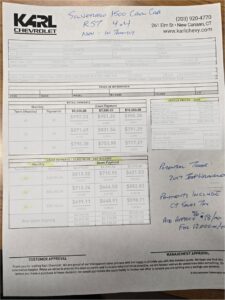
Ask for the out-the-door number. Request the total cost in writing — vehicle price, conveyance fee, tax, and registration — with no conditions attached. This is the only number that truly matters. You should expect a detailed quote like the one shown here, that outlines your TOTAL costs, including any downpayment and terms related to monthly finance or lease payments. If you can’t get this level of detail in advance, that should be a sign.
Know that the fee is negotiable. Connecticut law says so. Most dealers won’t volunteer this information, but you’re within your rights to ask.
Be wary of unusually low prices. If a vehicle price seems too good to be true, check whether the dealer is compensating with a higher-than-average conveyance fee. Sometimes the “bargain” vehicle costs more in the end.
The Bottom Line
The dealer conveyance fee is one of those costs that quietly separates the dealerships who are transparent from those who aren’t. It doesn’t make headlines. It doesn’t show up in a deal badge. But it can add hundreds of dollars to what you actually pay — and most shoppers never think to compare it.
At Karl Chevrolet, we think every dollar counts. That’s why we keep our fee low, disclose it upfront, and never use it to offset a misleading vehicle price. It’s one more way we try to earn the trust our family has been building since 1927.
Next in the series: Kelley Blue Book, JD Power, and the Real Market Value of Your Next Car — how to use trusted third-party tools to verify any dealer’s pricing claims.
Read the full series: SHOP SMARTER SERIES