
Details and History Matter – Learn what to look for in a CarFax Report
This post is part of our “Shop Smarter” series, helping consumers navigate today’s car market with confidence.
You’ve found a pre-owned vehicle you like. The price looks fair. The photos look great. But before you go any further, there’s one document that can tell you more about that vehicle than any test drive: the Carfax Vehicle History Report.
If you’ve been following our “Shop Smarter” series, you already know that deal badges can be misleading, that dealer fees vary wildly, and that independent pricing tools like KBB and JD Power can help you determine what a vehicle is worth. But all of those tools evaluate what a type of vehicle is worth. Carfax answers the question that matters most: what happened to this specific vehicle?
Here’s how to read a Carfax report — and what to look for before you buy.
The Five Sections That Matter Most
A Carfax Vehicle History Report compiles data from more than 150,000 sources — including state DMVs, insurance companies, dealers, repair shops, auction houses, and law enforcement agencies — into a single document. It can feel like a lot of information, but most of what you need to know falls into five key areas.
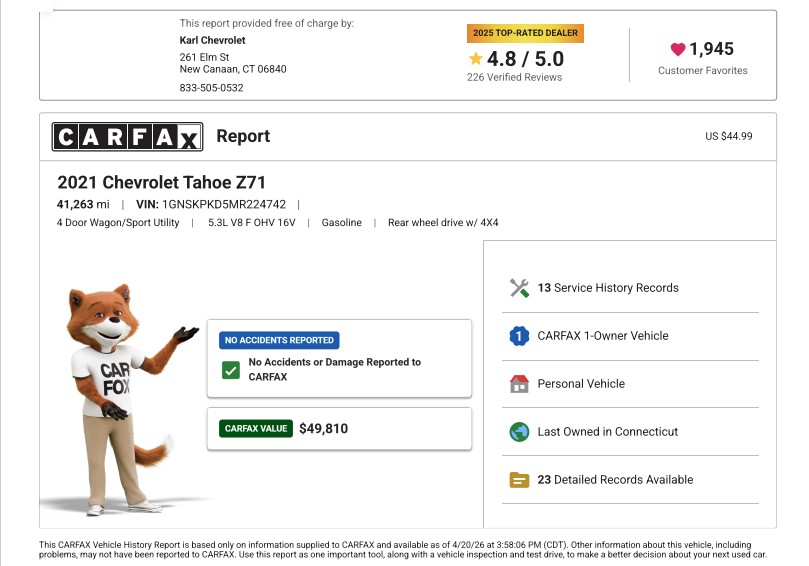
1. Ownership History. This tells you how many people have owned the vehicle, how long each owned it, where it was registered, and whether it was used for personal, commercial, or fleet/rental purposes. Each of these categories is not created equally. A personal use vehicle has generally been driven by one or a few drivers within a family, while a rental vehicle has been driven by many different drivers under many different conditions. Fewer owners is generally better — one-owner vehicles tend to have more complete records and more consistent care. And a vehicle that changed hands every year or two may be a sign that something wasn’t right.
2. Accident and Damage History. This is often the first thing buyers look for — and rightly so. Carfax categorizes reported damage as minor, moderate, or severe, and notes whether airbags were deployed or structural damage was sustained. Not every reported accident is a dealbreaker — a minor fender scrape is very different from a collision that triggered airbag deployment. Life happens to vehicles just as it does to people. But you want to know what happened and verify that repairs were done properly.
3. Service Records. This is where a Carfax report can really shine — or raise red flags. A vehicle with a detailed, consistent record of oil changes, tire rotations, brake services, and scheduled maintenance is a vehicle that’s been cared for. Gaps in the service history aren’t always a problem (some owners do their own oil changes, and not every independent repair shop reports data) but long stretches with no recorded maintenance are worth asking about.
4. Title History. Carfax checks for title issues that can significantly affect a vehicle’s value and even its ability to be registered or insured. Key flags here include salvage titles (meaning an insurance company declared the vehicle a total loss), lemon/manufacturer buyback titles, and flood damage. Any of these should prompt serious caution.
5. Open Recalls. Carfax lists any unresolved manufacturer recalls that affect the vehicle. Recall repairs are performed free of charge by any authorized dealer, so this isn’t a dealbreaker — but it is something you should address before or immediately after purchase. As a matter of good customer service, if a recall resolution is available from the manufacturer, you should expect your dealer to have that taken care of before you take delivery.
What Makes One Report More Valuable Than Another
Here’s something most car shoppers don’t realize: not all Carfax reports are created equal. The value of a report depends on how much data has been reported for that specific vehicle.
A vehicle that’s been serviced at the same dealership for its entire life will have a rich, detailed Carfax record — every oil change, every inspection, every tire rotation documented and time-stamped. You can see exactly what was done, when it was done, and by whom. That kind of transparency gives you real confidence in what you’re buying.
On the other hand, a vehicle that’s had multiple owners, been serviced at independent shops that don’t report to Carfax, or has long gaps between recorded services will have a thinner report. That doesn’t necessarily mean the vehicle wasn’t maintained, but it does mean you have less data to go on, which increases your risk.
This is one of the reasons Karl Chevrolet’s pre-owned inventory stands apart. Many of our vehicles were originally sold new right here at our dealership and have been serviced by our own technicians throughout their lives. When you pull up the Carfax on one of those vehicles, you’re not seeing a sparse timeline with question marks — you’re seeing a complete, detailed service record from a team that knows the car inside and out. That’s a level of verified history that’s hard to find anywhere else.
The History-Based Value: Carfax as a Pricing Tool
Beyond vehicle history, Carfax also provides something many shoppers don’t know about: a History-Based Value that estimates what a specific vehicle is worth based on its unique background.
Unlike KBB or JD Power – which calculate value based on year, make, model, trim, mileage, and market conditions – the Carfax History-Based Value adjusts for the factors that make each vehicle different: the number of owners, the completeness of the service record, whether accidents have been reported, and the type of use. A one-owner vehicle with a clean title and a full-service history from a single dealership will have a higher History-Based Value than the same model with multiple owners, gaps in service, and a reported accident.
As we discussed in our post on KBB, JD Power, and Carfax, using all three tools together gives you the most complete picture: KBB tells you what the market says, JD Power tells you how the model holds up over time, and Carfax tells you what actually happened to the car you’re considering.
Why Karl Chevrolet Is a Carfax Lifetime Dealer — and What That Means for You
Karl Chevrolet is a Carfax Lifetime Dealer, which means we provide a free Carfax Vehicle History Report with every pre-owned vehicle we sell. No asking. No upselling. No extra charge. It’s included because we believe transparency isn’t optional — it’s foundational.
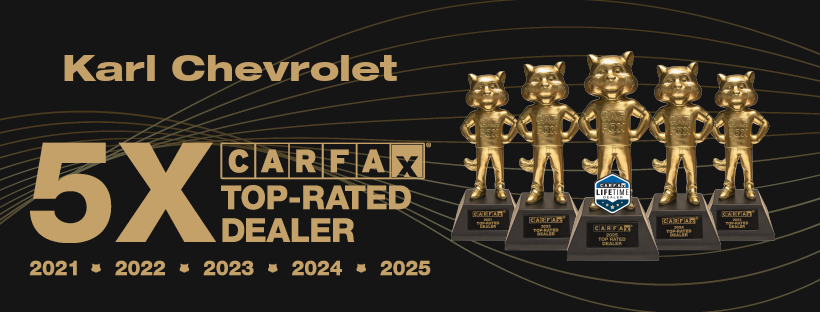
We’re also proud to be a Carfax Top-Rated Dealer for five consecutive years — every year since Carfax began issuing these awards in 2021. That recognition is based entirely on verified customer reviews, not advertising spend. Our 4.8-star rating and nearly 1,900 customers who have bookmarked us as their preferred dealer on Carfax reflect the relationships we’ve built over nearly a century of doing business the right way.
As a Lifetime Dealer, we also use Carfax for Life to deliver timely maintenance reminders to our customers — helping them stay on top of service schedules and protect the long-term value of their vehicle. It’s one more way we aim to build relationships that last well beyond the sale.
What to Do If a Dealer Won’t Provide a Carfax
If you’re shopping at a dealership that doesn’t offer a Carfax report — or charges extra for one — that’s worth paying attention to. Ask yourself: what might they not want you to see?
A dealer who is confident in the quality of their inventory has every reason to be transparent about vehicle history. A dealer who isn’t may be hoping you won’t look too closely. CarFax is the industry standard, and while there are some ‘competitive’ vehicle history check websites (such as AutoCheck), you should expect the best, most thorough and accurate history report possible – and that will be from CarFax.
As a word of caution, a recent post on Reddit highlighted a potential gap in data between one of those ‘other’ vehicle history sites and CarFax.
You can always purchase a Carfax report on your own at carfax.com — all you need is the vehicle’s VIN. But ideally, the dealer should be providing this for you. At Karl Chevrolet, it’s always included, because we believe the best customer is an informed customer. In the end, nothing is better than an in-person viewing of any vehicle, along with a decent test drive covering a range of driving environments.
The Bottom Line
A Carfax Vehicle History Report won’t tell you everything about a vehicle. It won’t catch unreported damage, and it can’t predict future problems. But it will tell you more about a car’s past than almost any other single source — and that past is one of the most important factors in determining what a vehicle is worth today.
When you combine a clean Carfax report with competitive pricing benchmarked against Kelley Blue Book and JD Power, a low and transparent dealer conveyance fee, and a dealership with a track record you can trust — you’re not just getting a good deal. You’re making a decision you can feel confident about for years to come.
That’s what shopping smarter looks like. And it’s what we’ve been helping our customers do since 1927.
This is the final post in our “Shop Smarter” series. We hope these guides have helped you navigate today’s car market with more confidence and clarity.
Read the full series: Car Shopping… What’s the Real Price?