
How Far Will It Really Go? The Truth About EV Range for Fairfield County Drivers
This post is part of our “Plugged In” series — Karl Chevrolet’s guide to EVs for Fairfield County drivers.
Of all the questions we hear from EV-curious drivers at Karl Chevrolet, range anxiety is the most common. And it’s a fair concern — nobody wants to be stranded on the Merritt Parkway with a dead battery and a car full of kids.
But here’s what years of EV conversations on our showroom floor have taught us: the gap between what people imagine range anxiety feels like and what EV owners actually experience is enormous. Almost without exception, the customers who come back to buy their second Chevrolet EV tell us the same thing — they worried about range before they bought, and they stopped worrying about a week after they drove it home.
Let’s work through the questions we hear most often, with honest answers specific to Fairfield County driving.
First, the Daily Math
Most Fairfield County residents drive between 30 and 80 miles on a typical day — commuting to the train station, running errands, school pickups, the occasional trip into the city or across county lines.
The 2027 Chevrolet Bolt offers 262 miles of EPA-estimated range. The Equinox EV offers 319 miles. Either way, the math is straightforward: the average Fairfield County driver uses somewhere between 10% and 25% of their available range on a typical day. And unlike a gas tank, an EV starts every morning full — charged overnight at home while you sleep, at the cost of roughly a dollar per gallon equivalent in electricity.
The honest answer to “will it have enough range?” for daily driving in this region is: comfortably, yes, with miles to spare.
“What About the Airport? I Get Stuck in Traffic for Hours.”
This is one of the most common concerns we hear — and it’s one where the reality of EV ownership actually works strongly in your favor.
JFK, LaGuardia, and Newark are all roughly 35 to 50 miles from most of Fairfield County, depending on where you live. Round trip, you’re looking at 70 to 100 miles of driving — well within comfortable range for any of our EV models. But the real concern is the traffic: what if you’re sitting in the departure drop-off loop, or inching through arrivals, engine running, for an hour?
Here’s the thing that surprises most people: an EV uses very little energy when idling. There’s no combustion engine turning over, no fuel being burned just to keep the vehicle running. Climate control draws some power, but it’s minimal compared to what a gas engine consumes sitting still. And in the stop-and-go crawl of airport traffic, your EV’s regenerative braking system is actually capturing energy back every time you lift your foot — energy that goes straight back into the battery.
The airport run, as it turns out, is one of the use cases where EVs perform best relative to gas vehicles — not worst.
“What About a Ski Trip to Vermont? What Does Cold Weather Do to Range?”
This is the other question that comes up every fall without fail, and it deserves a direct, honest answer.
Yes, cold weather affects EV range. Battery chemistry is less efficient at low temperatures, and heating the cabin draws more power than air conditioning does in summer. This is true of every EV on the market. Even gas engine vehicles do not get as good fuel economy in cold weather.
But here’s what’s changed with the current generation of Chevrolet EVs built on GM’s Ultium battery architecture: the cold weather impact is significantly less pronounced than it was on earlier EV platforms. Ultium-equipped vehicles use a heat pump for cabin heating rather than resistive heating elements — a fundamentally more efficient approach that pulls heat from the ambient air rather than generating it from scratch. The result is meaningfully better cold-weather range retention than the previous generation of EVs that many people’s mental model is still based on.
So what does that mean for a ski trip? Let’s use a specific example.
New Canaan to Stowe, Vermont is approximately 210 miles. On a cold winter day, accounting for realistic range reduction, an Equinox EV with 319 miles of rated range will still have substantial range to work with. You could make it to Stowe on a single charge under most winter conditions.
But if you want to arrive with plenty of range for local mountain driving — ski resort shuttles, dinner in town, day trips — we suggest a quick stop at the Charge Point ultra-fast charging station in Greenfield, Massachusetts, right off I-91. Twenty to thirty minutes there, and you arrive at your destination with a full battery and nothing to think about for the rest of the weekend.
And Greenfield isn’t your only option. Between New Canaan and Stowe, Vermont, there are more than 156 charging stations along the route — a number that would have been unimaginable just a few years ago. Fast charging stations are available throughout the I-91 corridor heading north, and along the Merritt Parkway for east-west travel. Virtually every rest area along these routes now has charging infrastructure. The network that Fairfield County EV drivers have access to today looks nothing like it did five years ago.
Here’s one more detail about the Vermont run that most people don’t know — and that actually works in your favor. The drive from Fairfield County to central Vermont is, on average, slightly uphill the entire way. You are gradually climbing in altitude from near sea level to mountain elevation, which means the northbound leg uses a bit more energy than your rated range would suggest — roughly 10% more in our experience.
But the reverse trip home? You’re heading downhill the whole way, descending from mountain altitude back toward the Connecticut coast. Regenerative braking captures that energy continuously. The return trip is remarkably efficient — with real-world range that can run 10-20% or more above your normal baseline. Many of our customers are genuinely surprised when they arrive home with more charge than they expected. It’s one of the quiet pleasures of driving an EV through New England terrain.
It’s also worth noting: the 2027 Bolt, the Equinox EV, and the rest of the Chevrolet EV lineup all include access to every public charging network in the country — including Tesla Supercharger stations. That access, via the NACS charging standard now adopted across the industry, means you’re never limited to a single network when you’re on the road. And, with the MyChevrolet app on your phone, you can now create ONE centralized account to pay for charging on almost all public charging networks – including ChargePoint, Tesla, EVgo, Blink, Electrify America, and more.
Plan Your Own Route — Before You Even Visit the Dealership
One of the tools we’re most proud of at Karl Chevrolet isn’t a vehicle — it’s a resource we’ve built directly into every EV listing page on our website.
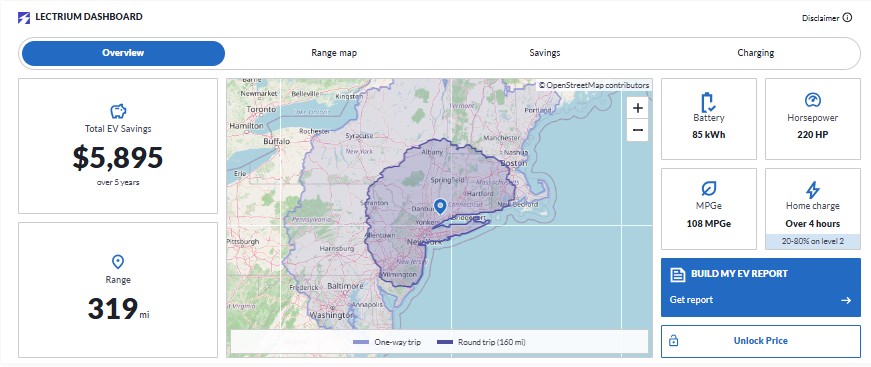
Each of our EV vehicle detail pages includes a range planning tool powered by Lectrium that lets you do exactly what we’d do for you in the showroom: enter your home or work address, see the vehicle’s realistic range for your specific round trip or one-way journey, and map out charging stations along any route you’re considering. It’s VIN-specific, which means the data is tailored to the actual vehicle you’re looking at — not a generic estimate.
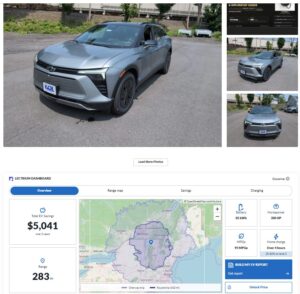 Want to know if a particular Equinox EV in our inventory will get you to your sister’s house in Albany and back without stopping? Simply click on that vehicle’s listing on our website to open the vehicle details page. You’ll see a map just like this. Enter the address. Want to see how many charging stations sit between New Canaan and Stowe before you commit to the ski trip? The tool shows you. You can explore all of this on your own schedule, at home, before you ever set foot on the lot.
The darker purple area will show you how far you can drive AND return home on a charge, while the lighter purple area will show how far from home you can travel on one charge before needing to plug-in to recharge.
We believe this is the kind of transparent, accurate information every EV shopper deserves — and it’s one more reason we’d encourage you to start your EV research at karlchevy.com rather than anywhere else.
One of our favorite things to say to EV-curious customers is this: nobody is going to force you to purchase an EV — but any local family with two or more vehicles in the driveway should seriously consider one for the sheer fun and efficiency of driving it.
Here’s what we see happen, over and over: a Fairfield County family adds an EV to their garage as the “around town” vehicle, keeping their gas car for longer trips. Within weeks, the EV has become the family’s first choice for almost everything. It’s quieter, smoother, faster off the line, and cheaper to fuel. The gas car sits in the driveway.
In fact, we’ve had more than a dozen local families do exactly this — and within a year, they’re back at 261 Elm Street shopping for their second EV. Not because anyone pushed them. Because the first one became the family’s favorite car to drive.
A Local Story Worth Sharing
We’d like to tell you about Patricia S., one of our Equinox EV customers, who discovered something important about her new vehicle in a way she didn’t plan.
Patricia had purchased her Equinox EV as an around-town car. The school run, local errands, the kinds of trips that make up the vast majority of daily driving for most families. But last summer, just before a scheduled family road trip, their gas-powered vehicle went in for repairs. Suddenly, the EV they’d been treating as a local car was going to have to carry the family on a longer journey than they’d ever planned for.
She called us, understandably nervous.
We walked through her route together using the MyChevrolet app — a tool that integrates directly with Google Maps to plan charging stops, calculate range, and display real-time charger availability along any route. We also loaned her one of our NACS adapters, which gives Chevrolet EV owners access to Tesla Supercharger stations in addition to every other public network, just in case she needed it.
The trip went off without a hitch. Patricia and her family arrived at their destination comfortably, the charging stops were quick and easy, and the Google Maps integration made the whole process feel no more complicated than stopping for gas. She called us when she got home to say she had nothing to worry about.
Her family is now, by her own description, a big fan of Chevrolet’s approach to public charging integration. And her Equinox EV is no longer just the around-town car.
Stories like Patricia’s are the reason we encourage every EV-curious customer to ask us the hard questions. The honest answers are almost always more reassuring than people expect.
The Bottom Line on Range
Range anxiety is real as a feeling. As a practical barrier to EV ownership in Fairfield County, it almost never holds up under examination.
For daily driving, the math is overwhelmingly in your favor. For airport runs, EVs actually have an advantage over gas vehicles in traffic. For a ski trip to Vermont, a brief and well-placed charging stop handles the longest leg of the journey — and the network to support it is already there.
What helps most is moving from the abstract (“what if I run out?”) to the specific (“how many miles do I actually drive, and where do I actually go?”). When you run that calculation against the range numbers on today’s Chevrolet EVs, the anxiety tends to dissolve.
We’re happy to run that calculation with you, for your specific driving patterns, right here at the dealership. Bring your commute, your airport run, and your Vermont ski trip — and we’ll show you exactly what your EV life would look like.
Next in the series: “Plug In at Home” — everything Fairfield County drivers need to know about home charging, Level 1 vs. Level 2, and why most EV owners start every morning with a “full tank.”
Browse our full EV lineup – from Bolt, Equinox EV, Blazer EV, to Silverado EV – at KarlChevy.com
Read the full PLUGGED IN series:
- Why Right Now May Be the Best Time to Go Electric – Karl Direct
- Fairfield County’s EV Leader: Experience Matters – Karl Direct
- Fairfield County EV Range Guide – Karl Direct
- Home EV Charging – Fairfield County Guide – Karl Direct