
Tahoe or Suburban? (And Why Either One Beats a Minivan for Fairfield County Families)
This post is part of our Truck & SUV Buyer’s Guide series, helping you find the right vehicle for your family and your life.
It’s the question we hear on our sales floor more often than almost any other: “Should we get the Tahoe or the Suburban?”
It’s a genuinely good question — and one that deserves a real answer, not a spec sheet. We’ll get there. But first, we want to address the question that sometimes comes before it, the one families ask a little more quietly: “Should we just get a minivan?”
We’ll address that one directly too.
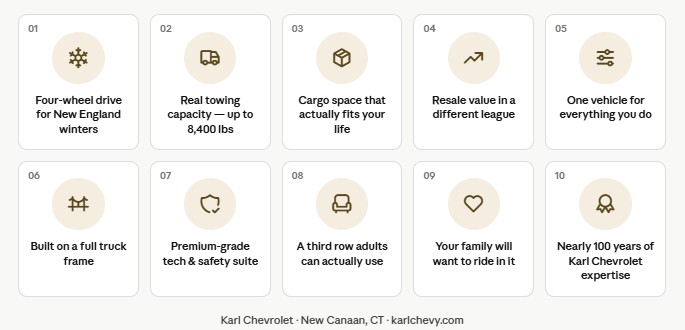
This post will explore The Top 10 Reasons a Tahoe or Suburban Beats a Minivan for Fairfield County Families
The Tahoe vs. Suburban Decision: What Actually Matters
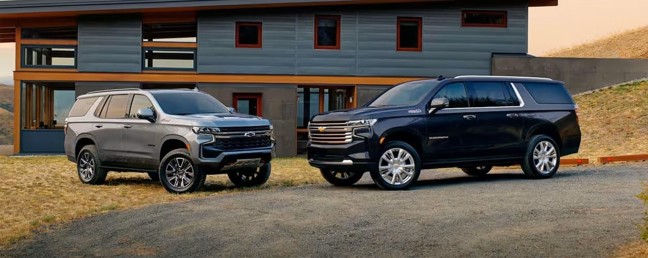
On paper, the 2026 Chevrolet Tahoe and Suburban are nearly identical vehicles. They share the same platform, the same three engine options, the same trim levels, the same technology suite, and the same fundamental character. The differences, while meaningful, are fewer than most people expect.
Here is the short version: the Suburban is 15 inches longer, and those 15 inches go almost entirely to the benefit of your passengers and your cargo.
Here is the longer version.
Size and Dimensions
The Tahoe measures 211.3 inches long with a 120.9-inch wheelbase. The Suburban stretches to 226.3 inches with a 134.1-inch wheelbase. Their widths and heights are nearly identical — about 81 inches wide and 76 inches tall on both — so the size difference is almost entirely about length.
In practical terms, that extra length means the Suburban fits in most of the same parking spaces and garages as the Tahoe. What it doesn’t fit in quite as easily is a tight urban parking garage, a narrow downtown street, or any place where you need to thread the needle quickly. For everyday Fairfield County driving — grocery runs in Darien, school drop-off in New Canaan, weekend errands in Greenwich — the Tahoe’s slightly smaller footprint is genuinely a notch easier to manage.
On the open road, the Suburban’s longer wheelbase pays dividends. It’s a more composed, planted highway vehicle, which matters if your family’s idea of a weekend involves heading up to the Berkshires or Vermont for skiing or a drive down the east coast to your favorite summer beach destination. And even in daily driving, ask most any Suburban driver, and they’ll tell you it’s easy to manage.
Cargo Space: Where the Suburban Pulls Away
This is the decisive stat for most families. Behind the third row, the Suburban offers 41.5 cubic feet of cargo space — compared to 25.5 in the Tahoe. That’s not a small difference. It’s the difference between fitting the hockey gear and the overnight bags or having to choose. And speaking of cargo space, both Tahoe and Suburban offer something no minivan does – and that’s the convenience of loading cargo through the wide-open rear liftgate or the super convenient pop-open rear window.
With all seats folded, the Suburban maxes out at 144.7 cubic feet total; the Tahoe at 122.7. In both cases, that’s more than most families will ever fill. But for the family that regularly travels with six or seven passengers and needs meaningful cargo space — think ski weekend with the whole crew — the Suburban’s rear section is a game-changer.
Third-Row Comfort
Both vehicles seat up to eight passengers (seven with available second-row captain’s chairs). But adults in the Suburban’s third row get 36.7 inches of legroom versus 34.9 in the Tahoe. Nearly two inches doesn’t sound significant until it’s your teenagers riding in the back to Mohegan Sun Arena for a concert, and suddenly those inches matter a great deal to them.
The second row in both vehicles can slide up to ten inches fore and aft, allowing a generous berth for third-row passengers when cargo space allows.
The Decision Nobody Expects: Center Row Bench or Buckets?
Here’s the conversation that often surprises first-time Tahoe or Suburban buyers, and one that ends up shaping how families actually live with these vehicles’ day to day.
Both the Tahoe and the Suburban offer a choice of second-row seating: a three-passenger bench seat or a pair of captain’s chairs (buckets). That choice determines whether you’re in an eight-passenger vehicle or a seven-passenger one, and the trade-offs go well beyond the headcount.
The case for captain’s chairs: Most families gravitate toward buckets, and for good reason. The open passage between the seats makes getting in and out of the third row genuinely easy. There’s no climbing over anyone, no folding seats forward. Third-row passengers also get a much better forward view of the road, which matters on long highway drives and makes a real difference for anyone prone to motion sickness. For older teenagers and adults on longer trips, captain’s chairs in the second row are simply more comfortable, with more personal space and no one jostling for elbow room. There’s also a practical parenting benefit some customers mention with a knowing smile: keeping kids at arm’s length during a long drive has been known to prevent a few mid-vacation territorial disputes from escalating.
The case for the bench seat: For families with three children, the bench configuration is often the better fit. All three kids can sit across the second row, which frees the third row for guests or carpool passengers, or lets you fold it flat for serious cargo capacity when you don’t need all the seats. The center row bench in the Tahoe and Suburban is genuinely wide, accommodating three adults comfortably, and it’s spacious enough for two full-size car seats side by side with room for an adult between them or toward one side. For younger families still in the full-car-seat era, that’s not a small thing.
The bench-or-buckets decision is one of the most personal choices in the configuration process, and it’s one we spend real time on with every customer. There’s no universal right answer, only the right answer for your family.
Powertrain: Identical Choices
Both models offer the same three engines:
- 5.3L EcoTec3 V8 – 355 horsepower, 383 lb.-ft. of torque. The standard choice, and the right one for most families.
- 6.2L EcoTec3 V8 – 420 horsepower, 460 lb.-ft. of torque. Available on upper trims. Worth considering if you tow regularly.
- 3.0L Duramax Turbo-Diesel – 305 horsepower, 495 lb.-ft. of torque. Outstanding for highway efficiency, and genuinely practical if your family logs serious mileage on the Connecticut-to-Vermont or Connecticut-to-Cape Cod runs.
All three pair with a 10-speed automatic transmission. Maximum towing is 8,400 pounds for the Tahoe and 8,300 for the Suburban, a difference so small it’s irrelevant for the vast majority of buyers.
 Safety
Learn why NHTSA (the National Highway Traffic & Safety Administration) awards their highest FIVE-STAR rating to both Tahoe and Suburban.
Price
Both vehicles share the same trim levels, from LS, LT, RST, Z71, Premier, and High Country, and the Suburban carries a modest premium over the equivalent Tahoe. The gap is typically a few thousand dollars at comparable trims. Whether that premium is worth it comes down entirely to how you use the vehicle.
The Simple Decision Framework
Choose the Tahoe if:
- You’re in and out of tighter spaces regularly (urban parking, congested school lots)
- The third row is used mostly for local trips and carpooling rather than long highway drives
- Your cargo needs are moderate – sports equipment, groceries, a reasonable weekend bag
- Budget is a meaningful factor at equivalent trim levels
Choose the Suburban if:
- Your family will routinely use the third row on longer road trips – the Suburban’s extra cargo capacity behind that row makes it the winning choice in a way no other vehicle can match
- You travel frequently with a full complement of passengers and need meaningful cargo space
- Adults regularly ride in the third row for extended periods
- Weekend travel involves significant gear (ski equipment, lacrosse or hockey bags, camping, sporting events)
- You want the extra composure and presence of the longer wheelbase
That last point deserves emphasis. When the third row is in use on a genuine road trip, not just a ten-minute carpool run, the Suburban’s rear cargo section becomes the deciding factor. It is, quite simply, the only vehicle on the market that offers the combination of three rows of genuinely comfortable seating and spacious, flexible cargo capacity behind all of them. Nothing else does both.
At Karl Chevrolet, we carry both. We recommend that anyone torn between them spend five minutes standing at the open tailgate of each. The difference in cargo depth is immediately clear — and that moment of clarity tends to make the decision for most people. In full disclosure, after all the years and thousands of customer interactions, we have never had a customer who was on the fence and decided to go with a Suburban regret their decision. If it is a close call, go with the extra cargo space. You will not regret it.
Now, About That Minivan
We want to be fair here. Modern minivans are genuinely capable, practical vehicles. The Honda Odyssey, Toyota Sienna, and Chrysler Pacifica are well-engineered machines that do what they’re designed to do. We’re not here to mock them.
But we have sold a lot of vehicles to Fairfield County families over the years, and we have watched a lot of those families trade in minivans — sometimes with barely concealed relief. What follows is our honest assessment of why, for families in this part of Connecticut, a Tahoe or Suburban tends to serve them better.
The Top 10 Reasons a Tahoe or Suburban Beats a Minivan for Fairfield County Families
 1. New England Weather Demands Four-Wheel Drive
Connecticut winters are not theoretical. Black ice on Route 123. Six inches of snow on a Tuesday morning with a 7:45 school start. An unexpected nor’easter on a Friday afternoon when you’re trying to get to the ski house before traffic.
The Tahoe and Suburban offer genuine four-wheel drive — not just all-wheel drive, but a real transfer case with low-range capability and, on Z71 models, enhanced skid plates and all-terrain tires. The Magnetic Ride Control suspension, available on both, adapts in real time to changing road conditions.
Minivans are front-wheel drive. Some offer AWD, but it’s a fundamentally different system designed for light traction assistance, not serious winter driving. In a Fairfield County winter, this is not a minor distinction.
 2. You Can Actually Tow Something
Many Fairfield County families have boats. They have camper trailers. They have horse, snow mobile, or jet ski trailers. They have that vintage camp trailer someone spotted on Facebook Marketplace and couldn’t pass up. And if they have a business, they may have landscaping equipment.
The Tahoe and Suburban each tow up to 8,300–8,400 pounds when properly equipped. They have a standard 2-inch receiver hitch, integrated trailer brake controller, trailer sway control, and the available Chevrolet Trailering App with Boat Ramp Assist, Trailer Tire Health monitoring, and Forward Path Indication.
Even if you don’t tow anything, the standard 2-inch receiver hitch is perfect for installing a rear-mounted cargo basket or bike carrier for those epic summer vacations.
A minivan tows, at most, 3,500 pounds — and that’s if you bought the right one and configured it properly. Try getting a 24-foot ski boat to Lake Candlewood in a minivan. We’ll wait.
 3. Real Cargo Space That Doesn’t Require Furniture Rearrangement
The Suburban offers up to 144.7 cubic feet of cargo capacity. The Tahoe delivers 122.7. Both fold their rear seats flat into the floor with a power assist on upper trims.
When the lacrosse team needs a ride and the equipment needs to come along. When the mountain bikes need to load for a weekend in the Berkshires. When someone’s heading to college in September and the contents of a bedroom need to fit. In all of these situations, the math works in your favor in a way it simply doesn’t in a minivan, where floor-level load height and sliding door geometry create constant logistical negotiation.
 4. The Resale Value Is in a Different League
This one is about money, and it’s significant.
Full-size Chevrolet SUVs are consistently among the highest-resale-value vehicles in their class. The Suburban, in particular, has historically held its value exceptionally well — something Karl Chevrolet customers have observed firsthand across multiple vehicle cycles. A well-maintained Suburban coming off a four- or five-year ownership cycle retains a meaningful portion of its original value.
Minivans depreciate more aggressively. They’re bought for practicality and priced accordingly when it’s time to sell. If you’re going to spend serious money on a family vehicle, it makes sense to think about what comes back to you on the other end.
 5. One Vehicle for Everything
Here’s the honest problem with the minivan: it’s excellent at one thing and awkward at many others. It’s a dedicated family hauler. The moment you need to tow, handle serious winter weather, carry oversized cargo, or project any capability beyond “ferrying children,” it reaches its limits.
The Tahoe and Suburban were designed around the idea of doing everything. They can tow the boat on Saturday, navigate a February snowstorm on Monday, carry eight passengers to a concert on Friday, and serve as the command vehicle for a weekend house renovation the following week. That versatility has real dollar value — it means you need one vehicle, not two.
 6. They’re Built on a Truck Frame
This isn’t nostalgia. It’s physics.
The body-on-frame construction of the Tahoe and Suburban gives them a durability and repairability advantage that unibody vehicles — including every minivan on the market — simply can’t match. They handle impacts better. They hold up to the abuse of real-world family life. And at Karl Chevrolet, we’ve seen Suburbans come through our service drive with 200,000 miles that look and drive like they’ve been treated well — because they have been, and because they’re built to last.
The Suburban history we explored in our previous post includes plenty of customers driving well past 300,000 miles. No one is writing those stories about a 2009 Odyssey.
 7. The Technology and Safety Suite Is Premium-Grade
Both the Tahoe and Suburban come standard with a 17.7-inch infotainment touchscreen — one of the largest in any vehicle in this segment — paired with an 11-inch digital driver display. Wireless Apple CarPlay, Android Auto, Amazon Alexa, and Google Built-In are standard. A Wi-Fi hotspot keeps the back-seat population occupied on long drives.
On safety, the available suite includes Automatic Emergency Braking, Lane Keep Assist with Lane Departure Warning, Blind Zone Steering Assist with Trailering, Rear Cross Traffic Alert, and on upper trims, GM’s Super Cruise hands-free highway driving assistance.
This is technology that was considered luxury-only five years ago. In a Tahoe or Suburban today, much of it is standard or available at modest cost.
 8. The Third Row Is Actually Usable
This is one of the most common complaints we hear from minivan converts: “We thought the third row would be useful, but it was only for small children.”
In the Suburban, third-row adults have 36.7 inches of legroom. In the Tahoe, 34.9 inches. These are numbers that actual adults can live with on a highway drive to the Cape, not numbers that adults endure while silently vowing never to ride back there again.
The second-row seats in both vehicles slide fore and aft up to ten inches, which means you can optimize the cabin layout for the people actually riding that day. That kind of flexibility is something a fixed-seat configuration simply can’t provide.
 9. Your Family Will Actually Want to Ride in It
We realize this sounds like a lifestyle argument, and it is. But it’s also a real one.
Teenagers in Fairfield County, like teenagers everywhere, have opinions. The family vehicle is a statement, not the primary factor in a vehicle purchase, but not zero either. We’ve watched plenty of family’s trade in vehicles their kids refused to be seen in, and we’ve watched plenty of other families whose kids actively looked forward to road trips because of the vehicle they drove.
The Tahoe and Suburban carry a presence and character that minivans, however practical, simply don’t project. Available 24-inch wheels on the 2025+ models, the bold front fascia refresh, the available RST sport appearance package, the High-Country luxury interior, these are vehicles that earn some enthusiasm from the people riding in them.
 10. Karl Chevrolet Knows These Vehicles Better Than Anyone in Fairfield County
We will close with a straightforward claim: no dealership in Connecticut, or really the entire northeast, has more experience with the Suburban and Tahoe than Karl Chevrolet. We have sold Suburban’s continuously since they were introduced in 1935. We have watched generation after generation of Fairfield County families put their trust in these vehicles.
We know which configurations work best for which families. We know which options are genuinely worth adding and which ones look good on a window sticker but rarely get used. We know what a well-maintained used Suburban is worth and what to look for in one. And when it’s time to sell or trade, we know what your vehicle is worth against a KBB and JD Power benchmark, no guesswork, no games.
That knowledge is available to you at 261 Elm Street, at no charge.
The Bottom Line
If you’re deciding between a Tahoe and a Suburban, the answer usually comes down to how many inches of cargo depth you actually need. Come in, stand at the open tailgate, and you’ll likely know within a minute.
If you’re deciding between either of those vehicles and a minivan, we’d ask you to think honestly about the full scope of what your family vehicle needs to do — in Fairfield County, in every season, over the life of the vehicle. Towing, winter driving, cargo capacity, long-term value, and a third row your whole family can live with are all part of that conversation.
We’re happy to have it with you. Stop by 261 Elm Street, visit us at karlchevy.com, or call us at (203) 966-9508.
We’ll have both on the lot. And yes, we can find you a very nice minivan too — we just might ask a few questions first.
Browse Karl Chevrolet’s current Inventory of NEW Tahoe and Suburban models.
Browse Karl Chevrolet’s current Inventory of PRE-OWNED Tahoe and Suburban models.
Previously in this series: 90 Years and Counting: The History of the Chevrolet Suburban
Next in the series: Crew Cab vs. Double Cab — What’s the Difference and Which Is Right for You?
Read the full Truck & SUV Buyer’s Guide series.