
90 Years and Counting: The History of the Chevrolet Suburban as Seen by Karl Chevrolet
This post is part of our Truck & SUV Buyer’s Guide series, helping you find the right vehicle for your family and your life.
The Chevrolet Suburban has been transporting families longer than any other automotive nameplate in U.S. history. Ninety years of continuous production. Twelve generations. Not a single model year missed. No other automotive nameplate comes close.
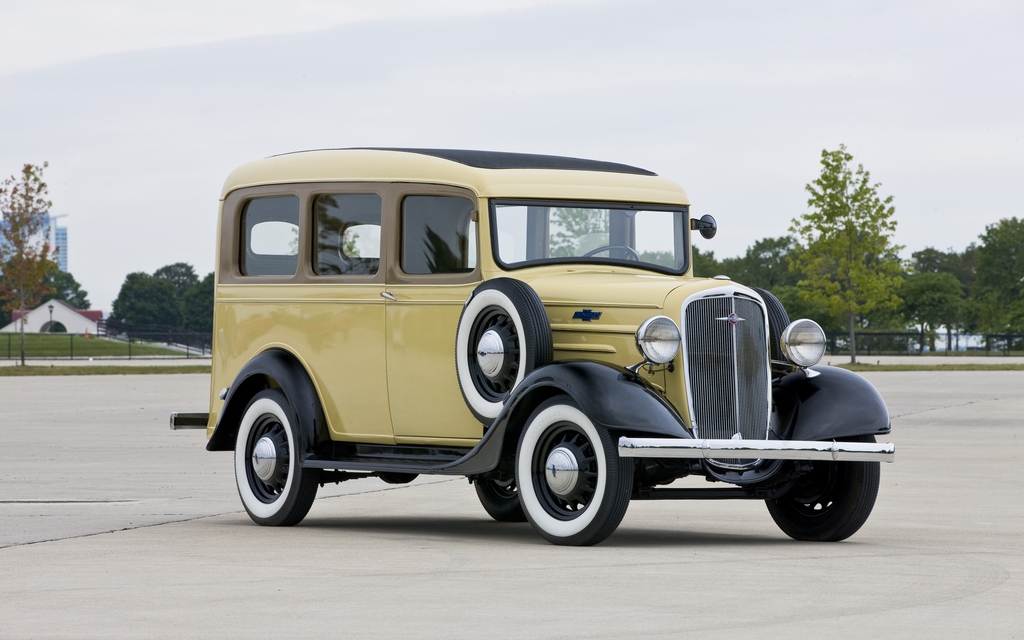
The iconic 1935 Chevrolet Suburban Carryall …. who would have guessed this nameplate would still be going strong 90 years later?
That kind of staying power doesn’t happen by accident, and at Karl Chevrolet, we’ve had a front-row seat for every mile of it. We have sold and serviced every generation of the Chevrolet Suburban since it debuted in 1935. Not most of them. All of them. From mountain snow in winter to seashore sand in summer, the Suburban has been the vehicle of choice for generation after generation of Karl customers and we’ve been right here to keep them going.
When we first wrote about the Suburban’s history back in 2010, we were celebrating its 75th anniversary. Now, fifteen years later, with our own dealership approaching its 100th year, it feels like the right time to bring that story up to date. The Suburban has changed more in the past decade and a half than in many of the previous decades combined. And through it all, it’s remained what it always was: the vehicle Fairfield County families trust when there’s a lot of life to carry.
How It Started: 1935 and the World’s First Crossover
The year was 1935. The Great Depression had forced American families to rethink priorities. Having one vehicle for work and another for pleasure simply wasn’t possible for most people. Chevrolet’s answer was a vehicle unlike anything that existed: the Suburban Carryall, a truck-based wagon that could haul cargo during the week and carry eight passengers on a weekend family trip.
It was, arguably, the world’s first crossover vehicle. And it came powered by Chevrolet’s dependable “Stovebolt” inline-six, producing 60 horsepower. While modest by any modern measure, it had more than enough for the roads and expectations of the era.
To put 1935 in context: the U.S. population was just over 127 million. A first-class stamp cost three cents. The Detroit Tigers had just won the World Series. Much has changed since then. The Suburban is still here.
Growing Up American: The Timeline
The Suburban’s story is the story of American life in the 20th century: work, family, the open road, and the slow, steady march toward comfort and capability. Here is how it unfolded:
1935: The Suburban Carryall is introduced with a two-door body style that would last through 1967. Eight-passenger seating. A 75-inch-long cargo area when the seats were removed. A heavy-duty chassis that immediately attracted professional buyers.
1937: New Art Deco-influenced styling. Horsepower climbs to 79.
1942–1946: Civilian production halts for World War II. Suburban bodies are pressed into military service, an early signal of a durability reputation that would only grow.
1947: The first significant post-war redesign. The inline-six produces 174 lb.-ft. of torque at just 1,200 rpm, giving the Suburban genuinely useful towing capability for the first time.
1950: Customers can choose between a rear tailgate with top-opening window or the beloved “barn doors”, a debate that Karl Chevrolet customers would still be having twenty years later.
1955: Revolutionary “second series” styling introduces the wraparound windshield, flushes the body with the fenders, and most significantly, debuts the small-block V-8. An American icon meets an American engine.
1957: Factory-installed four-wheel drive offered for the first time, via the NAPCO “Powr-Pak” system.
1960: The C/K designation system is introduced: C for two-wheel drive, K for four-wheel drive. A distinction our New England customers found immediately relevant.
1967: All-new styling introduces a unique three-door arrangement; one door on the driver’s side, two on the passenger side. That made the Suburban a favorite of ambulance companies and, before long, growing families with car seats to wrestle.
1973: A landmark year. Four conventional doors arrive for the first time, along with a wheelbase of 129.5 inches, just half an inch shorter than the 2010 model, four decades later. The three-quarter-ton 2500 model debuts with a 454 big-block option producing 335 lb.-ft. of torque.
1975: Interior comfort becomes a genuine priority. Simulated buffalo hide vinyl, wood-grain dash inserts, fully trimmed door panels. The Suburban begins its slow transformation from workhorse to family staple.
1981: Stacked rectangular headlamps mark the decade’s styling update. Automatic locking hubs arrive on 4WD models.
1987: Electronic fuel injection and a four-speed overdrive transmission bring meaningful efficiency improvements.
1992: A watershed redesign, the most dramatic in decades. Flush glass, composite headlamps, four-wheel anti-lock brakes, and a carlike ride from an all-new suspension. For many customers, this was the Suburban that introduced them to the nameplate for life.
1998: OnStar debuts. The Suburban becomes one of the first consumer vehicles connected to emergency assistance services. OnStar would become a feature that would prove its worth on New England winter nights more times than we can count.
2000: A new generation with new everything: the Vortec 5.3L and 6.0L V-8 engines from the same LS family as the Corvette, four-wheel disc brakes, and a load-leveling suspension. The 2500 series could tow up to 12,000 pounds with the available 8.1L engine.
2007: The 10th generation arrives, sleeker, more aerodynamic, and larger than anything before it. A steeply raked windshield, wider stance, and a new six-speed automatic transmission (arriving in 2008) brought the Suburban firmly into the modern era.
2010: The 75th anniversary is marked with the limited-edition Diamond Edition. Finished in White Diamond Tricoat paint, 20-inch chrome-clad wheels, heated and cooled leather seats, and remote start. Just 2,570 were built, and Karl Chevrolet was honored to receive a special allocation. If you bought one from us that year, you have something worth keeping. We have a few local owners of these models still going strong and relying on us for their service needs.
The Last 16 Years: Where the Suburban Became Something New
When we published our original history post in 2010, we noted that each new Suburban seemed to draw the same reaction from longtime owners: “This is the best one yet.” The 2010 Suburban, with its Diamond Edition and refined powertrain, felt like a high-water mark at the time.
Then Chevrolet did it again. Three more times.
2015 — The 11th Generation: Sharper, Smarter, More Connected
The 2015 redesign was the most comprehensive overhaul in years. The styling went sharper and more sculptural — a distinct departure from the rounded forms of the 2000s. The engine was updated to the 5.3L EcoTec3 V8, producing 355 horsepower and an estimated 23 mpg on the highway in rear-drive configuration. Towing capacity reached 8,300 pounds.
Two changes defined this generation more than any spec sheet could. First, the heavy-duty 2500 model was discontinued — a reflection of how thoroughly the Suburban had evolved from its working-roots origins into a premium family hauler. Second, the third-row seat finally folded flat into the floor, eliminating the need to wrestle heavy bench seats out of the cargo area on moving day or ski trip weekend. Customers who had been waiting years for that change had a simple reaction: finally.
The connectivity features took a significant leap too: Chevrolet’s MyLink touchscreen, Wi-Fi hotspot capability, multiple USB ports, and available rear seat entertainment brought the Suburban in line with what Fairfield County families expected from a vehicle that was, in many cases, serving as a mobile command center for family life.
For the 2019 model year, Chevrolet added the RST Performance Package — pairing the 6.2L V8 with a new 10-speed automatic transmission for 420 horsepower. It was the first time that engine had been available in a Suburban since the 454 big-block days, and it attracted a new set of customers who wanted luxury-level comfort alongside genuine performance credentials.
2021 — The 12th Generation: The Most Important Redesign in Decades
If there was one change that Suburban owners had requested for years, it was independent rear suspension. For decades, the Suburban’s solid rear axle had been a point of pride among those who valued towing durability — and a point of friction for those who wanted a more refined ride for daily family driving.
In 2021, Chevrolet finally made the switch, and the results were transformative. Independent rear suspension allowed engineers to dramatically drop the rear floor, creating 144.7 cubic feet of maximum cargo space — more than any previous Suburban. It also gave third-row passengers noticeably more legroom, with the second-row seat sliding up to ten inches fore and aft to accommodate different configurations. For families with teenagers in the back row, this was not a small thing.
The powertrain story was equally significant. The 12th generation offered three engines for the first time: the 355-hp 5.3L V8 as the standard, the 420-hp 6.2L V8 as an upgrade, and an all-new 3.0L Duramax inline-six diesel producing 277 horsepower and 460 lb.-ft. of torque. The diesel option — rare in a full-size SUV — returned an EPA-estimated 23 mpg combined, making it genuinely practical for families with long commutes or regular highway miles. In Fairfield County, where a trip up to the ski house in Vermont or down to the Cape is a regular part of life, the range and efficiency of the diesel have made a lot of sense for a lot of customers.
The 12th generation also introduced the High Country trim level — the most luxuriously appointed Suburban in the model’s history. And it arrived just as pandemic-era demand for large, capable family vehicles was accelerating. (As we noted in our brand story post, we did not charge above MSRP during that period — even when waiting lists would have made it easy to do so.)
2025 — The Mid-Cycle Refresh: When “Refreshed” Feels Like Reinvented
Chevrolet unveiled the 2025 Suburban refresh in late 2023, and it delivered more than a typical mid-cycle update. The exterior received a new front and rear fascia with angular LED lighting that brings the Suburban’s face in line with the broader Chevrolet truck family — more aggressive, more deliberate, more modern. Available 24-inch wheels push the visual stance to a level that would have been unthinkable on a Suburban twenty years ago.
Inside, the update was equally meaningful. A standard 17.7-inch diagonal infotainment screen — one of the largest in any full-size SUV — replaced the previous unit, paired with an 11-inch digital driver information center. The Duramax diesel engine was upgraded to 305 horsepower and 495 lb.-ft. of torque, a 10 percent power increase. GM’s Super Cruise hands-free highway driving assistance became available on select trims, representing a genuine step toward the driver-assistance technology customers have come to expect from premium vehicles in this class.
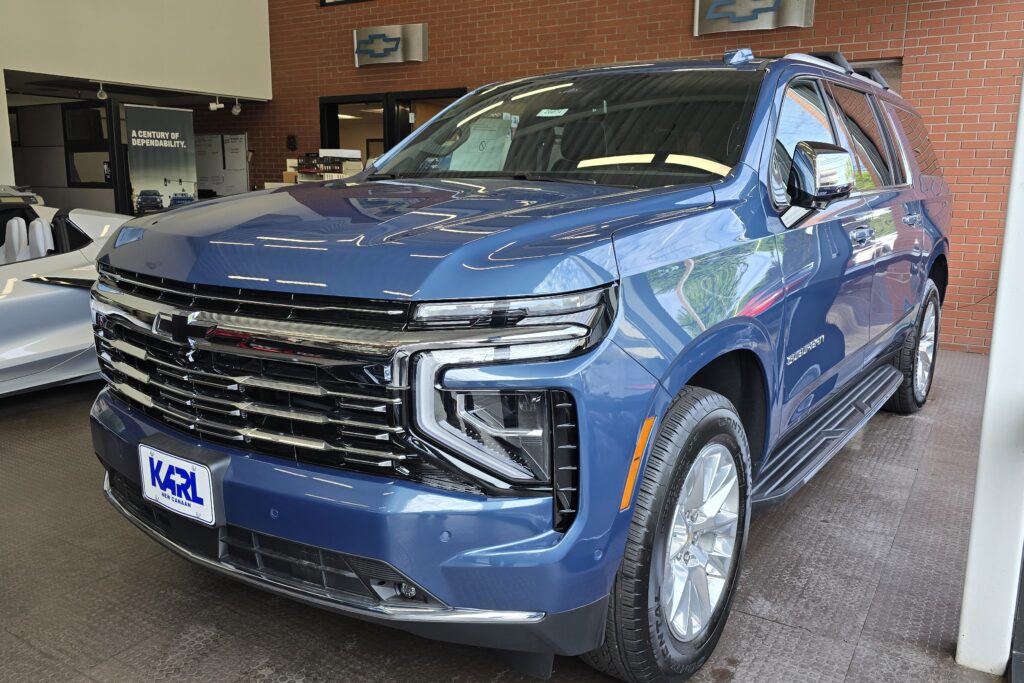
2026 Chevrolet Suburban in Premier Trim finished in Lakeshore Blue Metallic Exterior
Karl Chevrolet and the Suburban: A Story Still Being Written
For the Karl family, the Suburban’s history isn’t just automotive history — it’s personal.
When Leo Karl Sr. opened the doors on Railroad Avenue in 1927, he couldn’t have imagined that one particular Chevy model would become the backbone of a dealership’s identity for nearly a century. But by the time Leo Karl Jr. was raising his own growing family in the 1960s, the choice was obvious: he drove a Suburban. It had the space, the capability, and the durability that New England family life demanded.
Through the 1970s and ’80s, as the Suburban was still a niche product that most Chevy dealers couldn’t stock or even describe, Karl Chevrolet built a regional reputation as the place to find one. Customers from Rhode Island, suburban Boston, Long Island, northern New Jersey, and upstate New York made the trip to New Canaan — because our staff knew Suburbans and always had one available to test drive. Word of mouth spread at campgrounds, horse shows, boat ramps, and ski lodges. Long before the internet, Suburban owners found each other and sent each other to us.
In the 1990s, we specialized in personalizing Suburbans in ways that no one else was doing: custom audio systems, built-in walnut and marble humidors, running boards, electronics packages, and more. If a customer could imagine it, we figured out how to build it.
What we couldn’t have anticipated then was where the relationship would go. Over the years, we’ve watched young couples take delivery of their first Suburban and return four years later for the next one. We’ve watched their kids grow up, go to college, and come back for a Suburban of their own. We’ve sold Suburbans to grandparents who swore they’d downsize after the kids left — and then discovered, to no one’s surprise, that grandchildren require a Suburban all over again.
The Suburban has always had a particular hold on Fairfield County. The combination of New England winters, active family schedules, weekend travel, and a genuine appreciation for a vehicle that can do everything without apologizing for its size — it’s a natural match. Over the years, we’ve been asked more times than we can count to recommend a vehicle for a family “stepping up” from a crossover or minivan. The answer has often been the same.
And because Karl Chevrolet sells so many new Chevy Suburbans, it only makes sense that Karl has become the go-to dealership for families throughout the northeast looking for a well-maintained used Suburban. Some of our pre-owned Suburbans today were sold new right here at 261 Elm Street and have never been serviced anywhere else. When those vehicles come through our service drive, they carry a history we know by heart.
The Vehicle That Keeps Earning Its Keep
In a market full of crossovers, three-row SUVs, and vehicles that promise Suburban-like space in a smaller package, the genuine article keeps selling. Because for customers who have lived with one, there’s no substitute for the combination of full-frame construction, a real V8 or diesel engine, genuine towing capability, and the kind of interior space that allows an entire family to travel in comfort without anyone’s elbows in anyone else’s space.
Ninety years in, the Suburban is not a legacy product hanging on by reputation. The 2025 model is, by every objective measure, the best Suburban ever built — more capable, more comfortable, more connected, and more refined than any of its predecessors. It is also the most expensive, which means the conversation we have with customers has become more nuanced: Is the full Suburban the right choice, or does the Tahoe meet your needs? Is the diesel worth it for how you drive? Which trim level gives you what you actually use without paying for what you don’t?
Those are exactly the conversations we love to have. And they’re what the rest of this Truck & SUV Buyer’s Guide series is built around.
The Timeline: 90 Years at a Glance
1935: First Suburban Carryall introduced on a half-ton commercial chassis. Two-door body, 60-hp inline-six, seats eight.
1937: Restyled with Art Deco cues; horsepower increases to 79.
1942–46: Civilian production suspended for WWII; military Suburbans built throughout.
1947: Post-war redesign. 174 lb.-ft. of torque at 1,200 rpm enables serious towing.
1950: Tailgate/top window or barn-door rear end — customers choose.
1955: Wraparound windshield, flush body panels, and the debut of the small-block V-8.
1957: Factory four-wheel drive available for the first time.
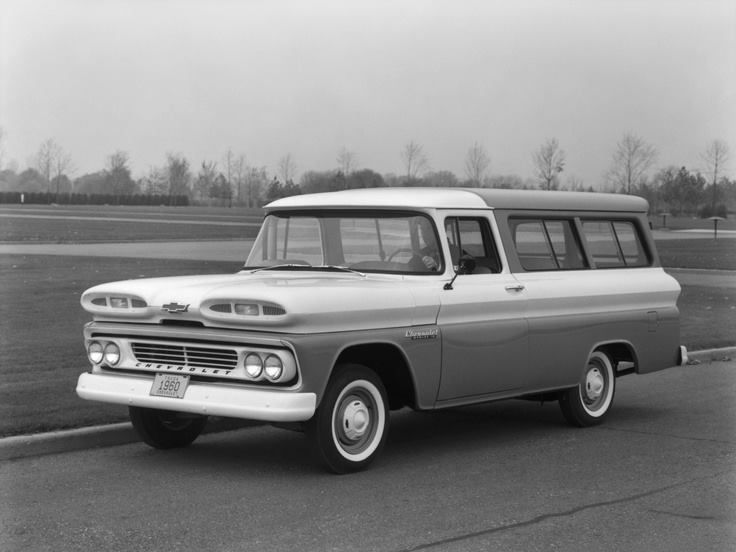
A classic 1960 Chevrolet Suburban Carryall.
1960: C/K two-wheel/four-wheel drive designations introduced.
1967: Three-door body style; popular with ambulance fleets and large families.
1973: Four-door configuration debuts. Wheelbase of 129.5 inches. Three-quarter-ton 2500 model arrives with 454 big-block.
1975: Interior comfort upgrades begin a gradual transformation toward premium family hauler.
1987: Fuel injection and overdrive transmission bring efficiency improvements.
1992: Major redesign: flush glass, composite headlamps, four-wheel ABS, independent front suspension.
1998: OnStar debuts in the Suburban.
2000: New LS-family V-8 engines (5.3L and 6.0L), four-wheel disc brakes, load-leveling suspension.
2007: 10th generation — aerodynamic redesign, larger body, new six-speed automatic.
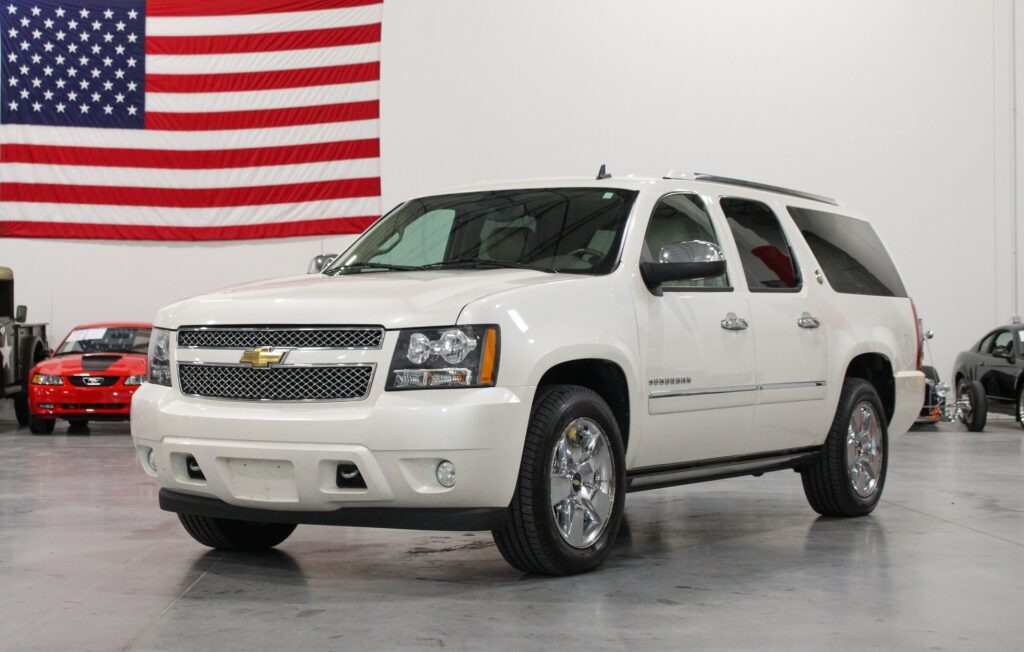
2010 Chevrolet Suburban – 75th Anniversary Diamond Edition
2010: 75th Anniversary Diamond Edition. Limited to 2,570 units. Karl Chevrolet receives special allocation.
2015: 11th generation — EcoTec3 5.3L V8 (355 hp), fold-flat third row, available 8-inch touchscreen, Wi-Fi hotspot. Heavy-duty 2500 discontinued.
2019: RST Performance Package adds 6.2L V8 and 10-speed automatic (420 hp).
2021: 12th generation — independent rear suspension (first ever), 144.7 cu. ft. of cargo space, available 3.0L Duramax diesel (277 hp / 460 lb.-ft.), sliding second row, High Country trim introduced.
2025: Mid-cycle refresh — new front/rear fascia, 17.7-inch infotainment screen, upgraded Duramax diesel (305 hp / 495 lb.-ft.), available 24-inch wheels, GM Super Cruise available.
Still Here. Still Earning It.
The Suburban turns 90 this year. Karl Chevrolet turns 98. It’s been quite a ride — and we’ve seen every mile of the journey, from the first Carryall to the latest High Country, from the back roads of New Canaan in a February snowstorm to the boat ramps of Long Island Sound on a July afternoon. The two stories have been intertwined for almost every one of those years, in a small town in Connecticut where family and community have always mattered more than trends.
As we approach our own centennial, we remain, as always, the area’s best source for new, Certified Pre-Owned, and pre-owned Suburbans — vehicles we know intimately, from first sale to final mile.
If you’re thinking about a Suburban, we’d love to talk about it. Stop by 261 Elm Street, visit us at karlchevy.com, or call us at (203) 966-9508. Or, if you prefer, you can begin by building your dream Suburban using Chevrolet’s build and price tool online from the comfort of your home or office.
We’ll have one ready for you to drive.
Next in the series: Tahoe vs. Suburban — How to Choose — a practical guide to the question we get asked more often than any other.
Read the full Truck & SUV Buyer’s Guide series.